Government vs Private De-Addiction Centers — Full Comparison
When a family starts looking for addiction treatment, one of the first and most important questions is — “Should we go with a government de-addiction center or a private one?” Both have their own strengths and limitations, and the right choice depends on the patient’s needs, budget, and circumstances.
In this article, we’ll break down the key differences between the two, so you can make an informed decision.
Disclaimer: This article is for general informational purposes only. Before choosing any center, always verify its government registration, license, and the qualifications of its medical staff.
What Is a Government De-Addiction Center?
Government de-addiction centers are run or funded by the central or state government (such as under the Ministry of Social Justice and Empowerment). Their primary goal is to provide affordable or free treatment, especially for lower-income families.
What Is a Private De-Addiction Center?
Private de-addiction centers are operated by private organizations, trusts, or NGOs. They typically offer more personalized care, modern infrastructure, and faster admissions — but at a higher cost.
Also visit us : Cost of Deaddiction Treatment in Dheradhun: Complete Guide.
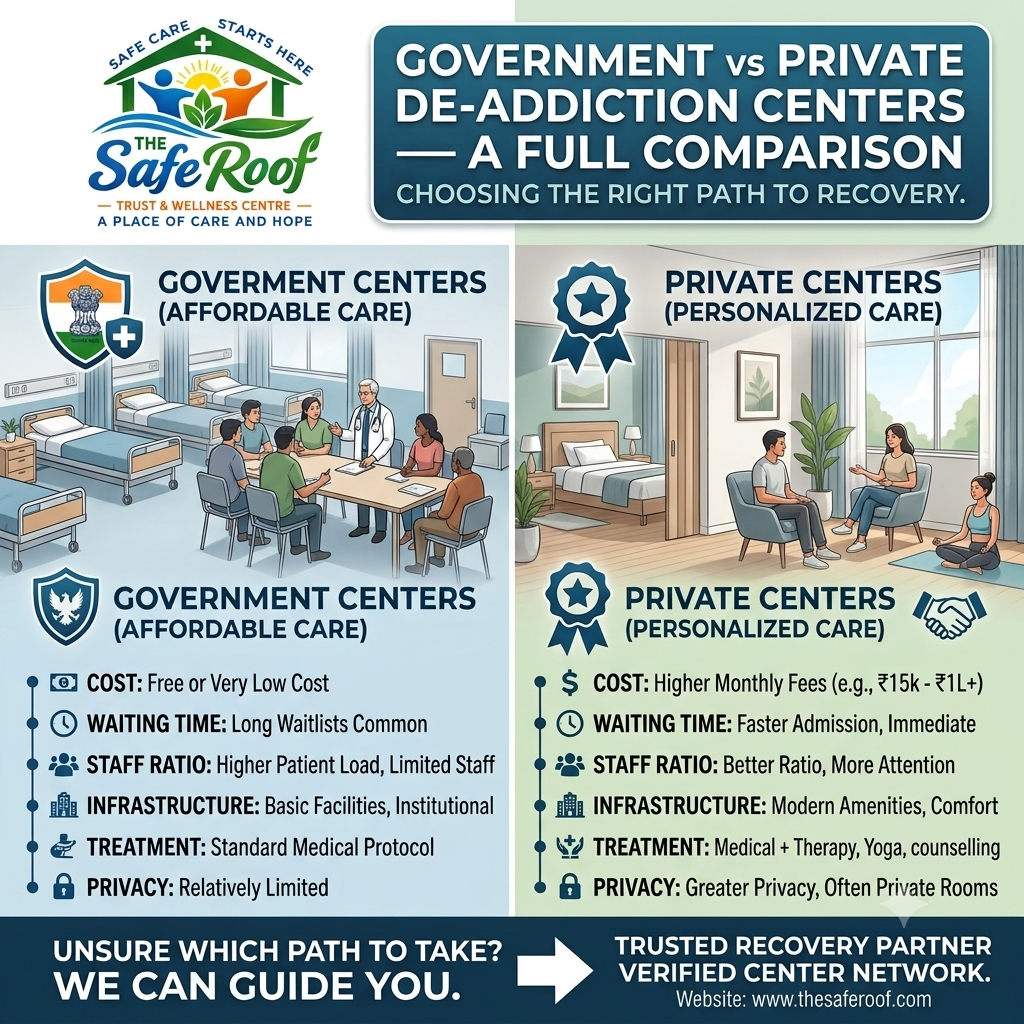
Government vs Private De-Addiction Center — Key Differences
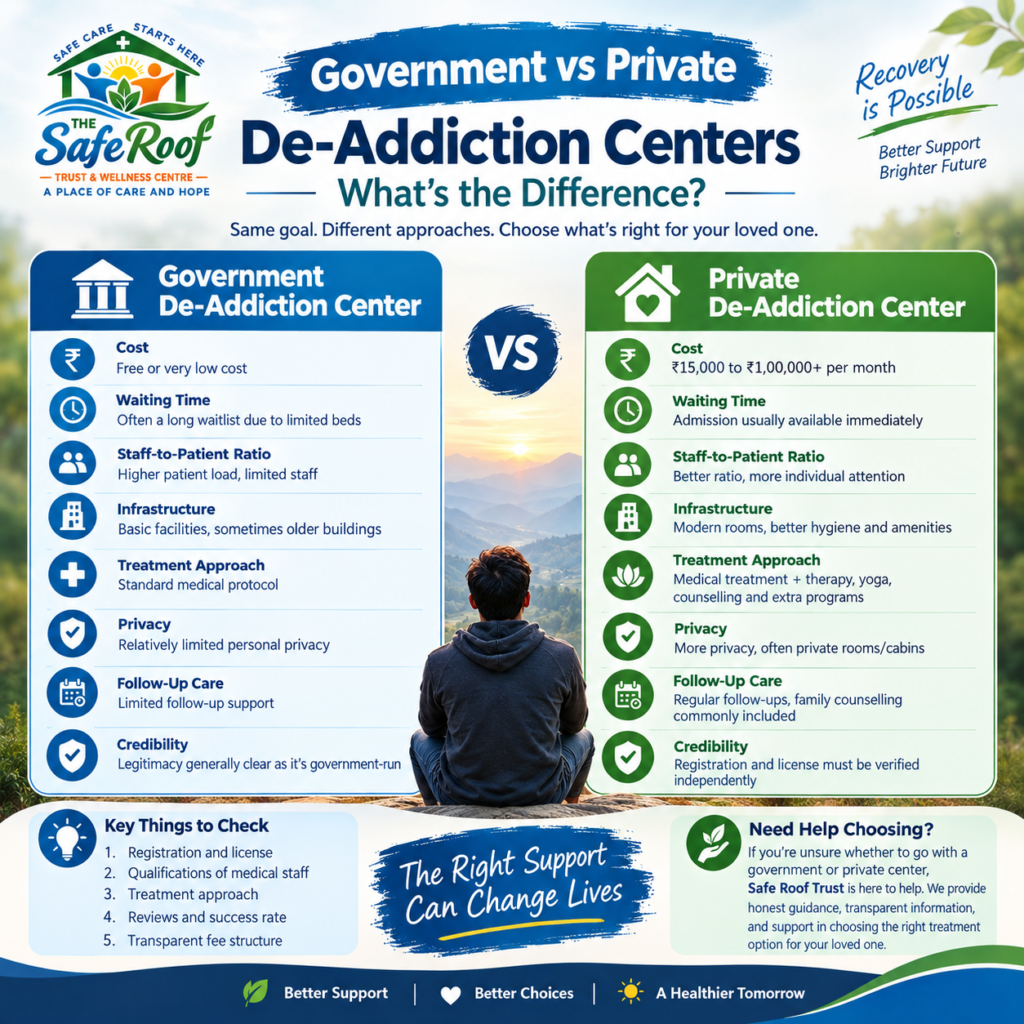
Factor | Government Center | Private Center |
Cost | Free or very low cost | ₹15,000 to ₹1,00,000+ per month |
Waiting Time | Often a long waitlist due to limited beds | Admission usually available immediately |
Staff-to-Patient Ratio | Higher patient load, limited staff | Better ratio, more individual attention |
Infrastructure | Basic facilities, sometimes older buildings | Modern rooms, better hygiene and amenities |
Treatment Approach | Standard medical protocol | Medical treatment plus therapy, yoga, counselling, and extra programs |
Privacy | Relatively limited personal privacy | More privacy, often private rooms/cabins |
Follow-Up Care | Limited follow-up support | Regular follow-ups, family counselling commonly included |
Verifying Credibility | Legitimacy generally clear as it’s government-run | Registration and license must be verified independently |
Advantages of Government De-Addiction Centers
- Treatment is free or available at very low cost
- Government oversight ensures a basic standard of care
- The most reliable option for financially weaker families
Limitations of Government De-Addiction Centers
- Long waiting periods due to limited bed availability
- Higher patient load can mean less individual attention
- Infrastructure and amenities may be fairly basic
Advantages of Private De-Addiction Centers
- Faster admission process, without long waitlists
- Better staff-to-patient ratio and personalized care
- Additional programs like yoga, meditation, and family therapy
- Greater privacy and a more comfortable environment
Limitations of Private De-Addiction Centers
- Higher fees may not be affordable for every family
- Some unregistered or fraudulent centers exist in the market — caution is essential
- Quality and standards can vary significantly from center to center
Also visit : Cost of Deaddiction Treatment in Dehradhun: Complete Guide
How to Choose the Right De-Addiction Center
Before making a decision, be sure to check:
- Registration and license — The center should be government-recognized and properly registered
- Qualifications of medical staff — Verify the credentials of doctors, counsellors, and nursing staff
- Treatment approach — Does it offer only detox, or also counselling, therapy, and follow-up care?
- Reviews and success rate — Look into past patients’ experiences and recovery outcomes
- Transparent fee structure — Get clear fee details upfront to avoid hidden charges
Need Help Choosing the Right De-Addiction Center?
If you’re unsure whether to go with a government or private center, Safe Roof Trust is here to help. We provide honest guidance, transparent information, and support in choosing the right treatment option for your loved one.
Conclusion
Both government and private de-addiction centers serve an important role. If your budget is limited and you can accommodate some waiting time, a government center is a reliable option. If you need immediate, personalized, and modern treatment, a registered private center may be a better fit. Whichever option you choose, always verify the center’s credentials and staff qualifications first.
Frequently Asked Questions
Most government centers offer basic treatment free of cost or at a very minimal charge, though facilities can vary from center to center.
This depends on the center, facilities, and duration of treatment — typically ranging from ₹15,000 to ₹1,00,000+ per month.
Ask the center for their registration certificate and license, and cross-check with your state health department or the Ministry of Social Justice and Empowerment’s official listings.